Grand Junction’s uranium mining legacy is an important part of our local history—and something today’s homebuyers and property investors should understand.
The Grand Valley is a beautiful place to call home. From historic neighborhoods in Grand Junction to growing communities in Fruita and Palisade, our area offers a wide variety of homes and investment opportunities.
But there’s a piece of local history that many buyers may not know about: uranium mill tailings and their historical use in construction.
A little Grand Junction history
During the uranium boom of the 1950s and 1960s, Grand Junction became an important center for uranium processing.
The Climax Uranium Mill, located near what is now Las Colonias Park, operated as a uranium and vanadium processing facility from 1950 to 1970.
The mill produced millions of tons of tailings—the sandy waste material remaining after uranium ore was processed.
Between 1950 and 1966, some of those tailings were made available to contractors and residents.
They were used in:
- Concrete and mortar
- Foundation and construction backfill
- Driveways and sidewalks
- Roads and utility projects
- Other residential and commercial construction
According to the U.S. Department of Energy, approximately 300,000 tons of radioactive tailings were transported to more than 4,000 properties in the Grand Junction area.
At the time, the health risks were not fully understood.
Why does this matter today?
Uranium mill tailings can contain radioactive materials that produce radon gas.
As awareness of the health risks increased, government agencies began identifying and cleaning up contaminated properties.
Major cleanup programs have addressed thousands of affected sites over the decades.
However, understanding this history remains important when researching older homes, particularly those built or modified during the 1950s and 1960s.
An older home is not automatically contaminated, and a newer home is not automatically free of radon.
Naturally occurring radon can affect homes of any age, regardless of whether uranium tailings were used during construction.
What should buyers look for?
If you’re shopping for a home in Grand Junction, Fruita, Palisade, or the surrounding Grand Valley, consider adding these questions to your due diligence process.
1. Has the home been tested for radon?
Ask for previous radon reports, including the date, testing method, and measured concentration.
Remember that radon levels can change, so older results may not accurately represent current conditions.
2. Does the property have a mitigation system?
If so, ask when it was installed, who installed it, and whether the system has been maintained and retested.
A mitigation system is not necessarily a negative. It may indicate that a known issue has been addressed.
3. Is there a history of uranium mill tailings?
For older Grand Junction properties, ask about any known contamination investigations or remediation records.
Historical records may be available through government agencies responsible for uranium mill tailings cleanup.
A standard radon test measures indoor radon concentration; it does not determine whether contaminated tailings are present.
4. Should you conduct a new test?
Even when previous reports are available, a current radon test can provide valuable information before purchasing.
Professional short-term testing is commonly used during real estate transactions because results can be obtained relatively quickly.
What if a home tests high for radon?
 An elevated result doesn’t automatically mean you should walk away from the purchase.
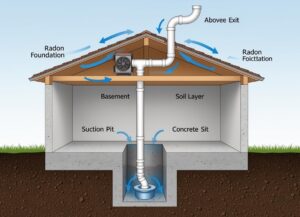
Radon mitigation is a common home improvement, and many properties can be successfully treated.
Buyers may be able to negotiate:
- Seller-funded mitigation before closing
- A price reduction
- Closing concessions toward mitigation costs
- An escrow arrangement for additional testing or mitigation, when permitted by the lender and closing parties
One option worth considering is negotiating funds toward mitigation and selecting your own qualified contractor after closing.
That allows you to evaluate the contractor’s qualifications, proposed system design, warranty, and long-term maintenance requirements.
Why long-term testing matters
Radon levels fluctuate with the seasons.
Here in Western Colorado, swamp coolers can affect indoor pressure and ventilation during the warmer months.
A short-term test provides a snapshot of conditions during the testing period.
A long-term test, typically conducted over more than 90 days, provides a better picture of average exposure. A full-year test is particularly helpful for understanding seasonal variations.
For buyers working within a standard closing timeline, a professional short-term test may be the most practical starting point, followed by longer-term testing after purchase.
Protecting your investment after closing
Once you purchase a home, radon testing should become part of your ongoing property maintenance and documentation plan.
This is particularly important if the home will become a rental property.
Maintaining accurate radon records can help with future sales, tenant disclosures, and maintenance planning.
How Elevate can help
At Elevate Property & HOA Management, we understand that a rental property is more than a building—it’s an investment worth protecting.
For owners purchasing or managing investment properties in Western Colorado, we’re developing a $100 Radon Testing Coordination & Recordkeeping Service.
Elevate can help coordinate testing through qualified professionals, organize results, maintain property records, and incorporate required radon information into tenant lease documentation.
We also help property owners navigate the broader responsibilities of preparing, leasing, and managing residential investment properties.
Have a Grand Valley investment property or planning to purchase one? Contact Elevate Property & HOA Management at (970) 644-6416 to learn more about our $100 radon testing coordination service.
Professional testing and laboratory charges, if applicable, are separate. Service availability is subject to applicable Colorado licensing requirements.
Elevate Property & HOA Management | Where Properties Thrive and Communities Rise
Serving property owners and investors throughout Western Colorado.