What is radon, how does it enter your home, and why should Colorado property owners care?
When we think about maintaining a healthy home, we often focus on things we can see: water leaks, mold, aging appliances, or structural repairs. But one of the most significant environmental health concerns in Colorado is something we cannot see, smell, or taste.
It’s called radon, and understanding it is an important part of responsible homeownership.
What exactly is radon?
Radon is a naturally occurring radioactive gas produced when uranium and radium in the earth break down. It exists in soil and rock throughout the country, but Colorado’s geology makes radon an especially important consideration for homeowners.
Radon is measured in picocuries per liter of air (pCi/L).
According to the Environmental Protection Agency (EPA), radon is the second-leading cause of lung cancer in the United States, after smoking. Long-term exposure increases lung cancer risk, including among people who have never smoked.
The challenge? The only way to know how much radon is inside a home is to test.
How does radon get into a house?
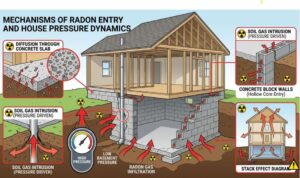
Believe it or not, your house can act like a vacuum.
As warm air rises and escapes through the upper portions of a building, it can create negative pressure near the foundation. This pressure difference can draw radon-containing soil gases into the home.
Radon commonly enters through:
- Cracks in concrete foundations and basement floors
- Gaps around plumbing and utility penetrations
- Crawlspaces and unfinished basements
- Construction joints and other openings connected to the soil
Even a newer, well-maintained home can have elevated radon levels.
What about homes with swamp coolers?
Here in Western Colorado, many homes use evaporative cooling systems, commonly called swamp coolers.
Because these systems introduce outside air, they can create positive pressure inside a home, reducing the amount of soil gas pulled through the foundation by forcing cool air into the home from top down.
However, that doesn’t mean a home with a swamp cooler is protected from radon.
Radon concentrations can change with the seasons, weather conditions, heating and cooling systems, and ventilation habits.
A home may have lower radon readings during the summer and higher readings when the swamp cooler is shut down and the heating system is running.
That’s one reason testing over an extended period can be so valuable.
How much radon is too much?
The EPA recommends taking action to reduce radon when levels reach 4.0 pCi/L or higher. It also recommends considering mitigation when levels are between 2.0 and 4.0 pCi/L.
The World Health Organization recommends a reference level of approximately 2.7 pCi/L where achievable.
No amount of radon exposure is completely risk-free, but reducing elevated concentrations can significantly reduce long-term risk.
How often should homeowners test?
Radon levels can change over time, even in homes that previously tested low.
Homeowners should consider retesting after significant renovations, changes to ventilation systems, or when beginning to use a basement as living space.
Homes with existing radon mitigation systems also require ongoing monitoring and periodic retesting to ensure the system continues working properly.
Can radon be fixed?
Yes! Elevated radon levels can often be reduced through professionally installed mitigation systems.
One common approach uses piping and a specialized fan to collect soil gases beneath the foundation and safely vent them outdoors.
A properly designed system can substantially reduce indoor radon concentrations.
The key is choosing a qualified, licensed professional and verifying the results after installation.
How Elevate can help
At Elevate Property & HOA Management, we believe protecting a rental property investment means looking beyond the obvious maintenance needs.
That’s why we’re developing a $100 Radon Testing Coordination & Recordkeeping Service for property owners.
Our service is designed to coordinate testing through qualified professionals, track results, maintain property records, and help ensure radon documentation is incorporated into tenant lease disclosures.
Whether you own one rental home or several investment properties, proactive testing and organized documentation can help protect your investment and keep you informed.
Contact Elevate Property & HOA Management at (970) 644-6416 to learn more about our $100 radon testing coordination service.
Professional testing and laboratory charges, if applicable, are separate. Service availability is subject to applicable Colorado licensing requirements.
Elevate Property & HOA Management | Where Properties Thrive and Communities Rise
Serving Grand Junction, Fruita, Palisade, and communities throughout Western Colorado.